3d Print technology

3D printing, also known as additive manufacturing, is a process where you create three-dimensional objects by placing layers of material on top of each other. 3D printing has many applications in various fields such as engineering, art, medicine and education. But not all 3D printers are the same. There are different types of 3D printing technologies that use different materials and methods to create objects. In this article we will compare four common types of 3D printing technologies: FDM/FFF, MSLA, DLP and SLS.

FDM/FFF
FDM stands for fused deposition modeling and FFF stands for fused filament fabrication. These are the most widely used types of 3D printing technologies, especially for hobbyists and makers. FDM/FFF printers use a thermoplastic filament as material, which is heated and extruded through a die on a build platform. The nozzle moves along the X and Y axes, while the platform moves along the Z axis, to create layers of the object. FDM/FFF printers are relatively inexpensive, easy to use, and compatible with a variety of materials, such as PLA, ABS, PETG, TPU, and more. But FDM/FFF printers also have some limitations, such as low resolution, poor surface quality, curvature and support structures.
MSLA
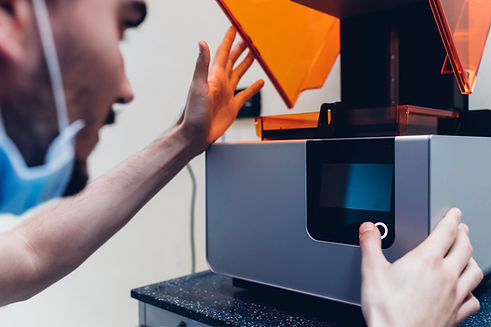
MSLA stands for masked stereolithography apparatus. This is a type of resin-based 3D printing technology that uses an LCD screen as a mask to selectively expose a layer of photopolymer resin to UV light. The resin hardens where the light hits it, forming a layer of the object. The build platform then moves up or down to expose the next layer of resin to the light. MSLA printers can produce high resolution and smooth surface objects with fine detail. But MSLA printers also have some drawbacks, such as high cost, limited material choices, toxic fumes, and finishing requirements.